Course Syllabus
Course Progress
all about makerspace
What is MakerSpace?
MakerSpace is a term for a place where people can come together to work on projects while sharing materials, ideas, and knowledge. They can focus solely on skills including but not limited to woodworking, electronics, sewing, electronics, and/or a combination of skills.
The concept of a space for making things & having a space to do so has existed as long as people can remember. Just think about craft rooms in houses, art tables in children’s play rooms, garage work benches. The concept of making things & having a space to do so in the school setting has existed for years. Just think about high schools that have a shop class where students learn carpentry and/or engineering in order to make things; home economics where students learn how to make things like food, sewing, etc; and elementary schools that have had art stations in their classroom.
There has been an increase in the Maker Movement in schools. President Obama’s 2009 “Educate to Innovate” campaign was a large catalyst in the Maker Movement as the campaign called for society to create ways to engage students in science & mathematics (Educate to Innovate). STEM highlights creating, building, and inventing – to be makers of things, not just consume. MakerSpaces answer this call by enabling students to have access to items and tools they can use to make things. This allows students to take ownership of their learning by doing & creating.
MakerSpaces have roots in MIT’s Fab Labs, which are labs designed in 2001 that focus on enabling students to make stuff not just learn stuff. Fab Labs emphasize making via technology. (Unleash Your Creativity In A Fab Lab)
benefits of makerspace
MakerSpaces foster a sense of community, enable hands on learning, allow for flexibility – thus, easy differentiation, and are multi-sensory to meet the needs of student’s different learning styles. MakerSpaces foster social emotional skills including building independence, confidence, perseverance, and growth by having students experiment, take risks, and play with their ideas. They invite cross-generational learning & lifelong learning as students see different generations working in makerspaces -from tinkering with their car, gardening, sewing, etc.
It provides another experience and setting which enables teachers to see the “whole child.” Teachers have reported having students in their classrooms who have difficulty attending and focusing which has resulted in behavioral, social, and academic concerns BUT when the teacher saw the student engage in the MakerSpace the teacher and the student’s peers saw the child in a whole new light! This new light highlighted the child’s creativity and abilities to make. These types of students have been reported to be one of the few students who have actually made a toy that would work in the real world and solved so many problems that the toy could be on the shelfs of stores. This turned the student into a leader in the classroom!
How can it look?
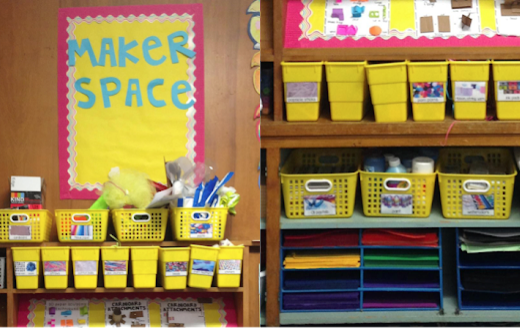
A MakeSpace can greatly vary in appearance. It can look like a box in the corner filled with materials that students can sit around and engage in. It can look like selves filled with neatly organized materials. It can look like a designated room filled with various materials from sewing machines, 3-D printers, dremel saws, robotics, stacks of egg cartons, a wall to build legos on, green screen, etc.
It can vary in name as well. MakerSpaces, Idea Labs, & Workshops are all makerspaces.
The focus should not be on what the MakerSpace looks like. It should be on having ITEMS in a PLACE where PEOPLE can gather to COLLABORATE as they MAKE THINGS.
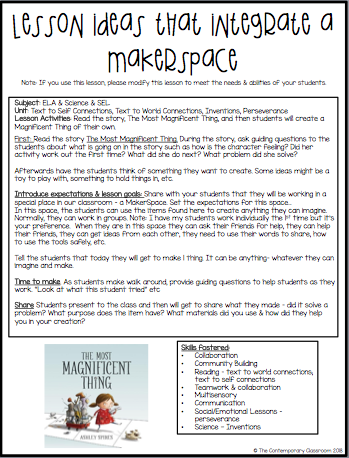
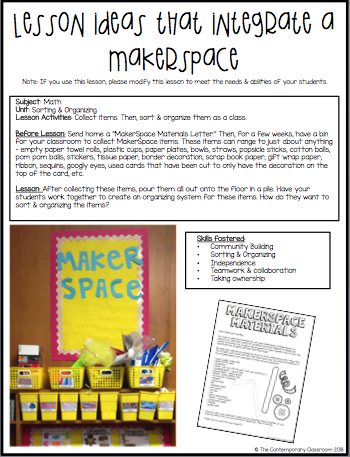
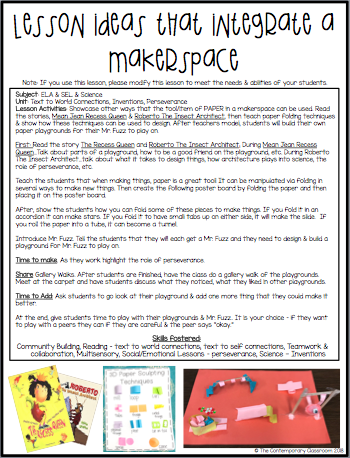
Makerspace lesson ideas
The lessons below incorporate use of a MakerSpace.
The importance of design thinking
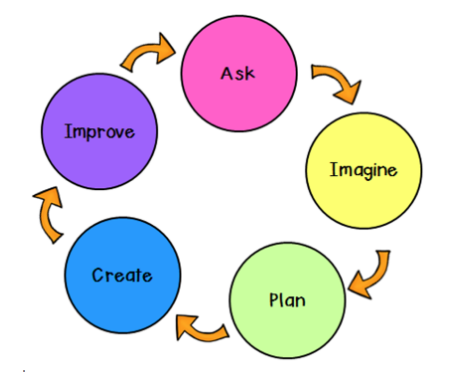
While it is important to have students explore and engage in the materials within a makerspace. Highlighting/teaching our students the PROCESS that makers go through while making allows them to grow as makers and expand their abilities.
how to gather materials
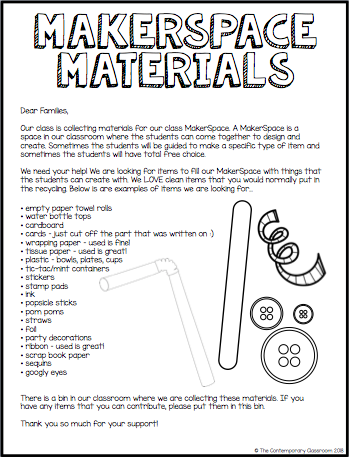
MakerSpaces need materials in order to happen. After all, if there is nothing to create with then the making doesn’t happen. Send a letter to your community – whether it be a class community, grade level, or campus community. Then, place bins outside your classroom, in the hallway of your grade level, or the front of the school so that people who bring items can place the items in those bins.
Note: Have a campus MakerSpace? Request 2-3 PTA volunteers or student leaders to help collect the MakerSpace items, keep them organized, and inventory certain items that may need to be requested occasionally.
Want a copy of the letter below? Click the “Download Lesson Ideas” button above. A copy of the letter is included in that document.
Bottom Line: Blended learning happens when a teacher blends together different instructional strategies, including authentic use of technology, to design and provide a fair & equitable learning environment that enables students to successfully engage in learning.
Comment Below
We want to hear from you! Have you participated in blended learning as a student before? If yes, when & how? Have you participated in blended learning as a teacher before? If yes, when & how? Respond via the comments section below!